


Hide targets for this goal
14.1 REDUCE MARINE POLLUTION

By 2025, prevent and significantly reduce marine pollution of all kinds, in particular from land-based activities, including marine debris and nutrient pollution
14.2 PROTECT AND RESTORE ECOSYSTEMS

By 2020, sustainably manage and protect marine and coastal ecosystems to avoid significant adverse impacts, including by strengthening their resilience, and take action for their restoration in order to achieve healthy and productive oceans
14.3 REDUCE OCEAN ACIDIFICATION
Minimize and address the impacts of ocean acidification, including through enhanced scientific cooperation at all levels
14.4 SUSTAINABLE FISHING

By 2020, effectively regulate harvesting and end overfishing, illegal, unreported and unregulated fishing and destructive fishing practices and implement science-based management plans, in order to restore fish stocks in the shortest time feasible, at least to levels that can produce maximum sustainable yield as determined by their biological characteristics
14.5 CONSERVE COASTAL AND MARINE AREAS

By 2020, conserve at least 10 per cent of coastal and marine areas, consistent with national and international law and based on the best available scientific information
14.6 END SUBSIDIES CONTRIBUTING TO OVERFISHING

By 2020, prohibit certain forms of fisheries subsidies which contribute to overcapacity and overfishing, eliminate subsidies that contribute to illegal, unreported and unregulated fishing and refrain from introducing new such subsidies, recognizing that appropriate and effective special and differential treatment for developing and least developed countries should be an integral part of the World Trade Organization fisheries subsidies negotiation
14.7 INCREASE THE ECONOMIC BENEFITS FROM SUSTAINABLE USE OF MARINE RESOURCES

By 2030, increase the economic benefits to Small Island developing States and least developed countries from the sustainable use of marine resources, including through sustainable management of fisheries, aquaculture and tourism
14.a INCREASE SCIENTIFIC KNOWLEDGE, RESEARCH AND TECHNOLOGY FOR OCEAN HEALTH

Increase scientific knowledge, develop research capacity and transfer marine technology, taking into account the Intergovernmental Oceanographic Commission Criteria and Guidelines on the Transfer of Marine Technology, in order to improve ocean health and to enhance the contribution of marine biodiversity to the development of developing countries, in particular small island developing States and least developed countries
14.b SUPPORT SMALL SCALE FISHERS

Provide access for small-scale artisanal fishers to marine resources and markets
14.c IMPLEMENT AND ENFORCE INTERNATIONAL SEA LAW

Enhance the conservation and sustainable use of oceans and their resources by implementing international law as reflected in UNCLOS, which provides the legal framework for the conservation and sustainable use of oceans and their resources, as recalled in paragraph 158 of The Future We Want
Related Publications


Related Events
Past Event

ISAP2025: Thematic Track 6 (ADD-1)
How do Socio-Ecological Production Landscapes and Seascapes (SEPLS) promote the Nexus Approach? – Integrating theory and practice
In December 2024, the Intergovernmental Science-Policy Platform on Biodiversity and Ecosystem Services (IPBES) approved the Nexus assessment which assessed the interlinkages between biodiversity, water, food, and health. The term, “Nexus approach”...
Past Event
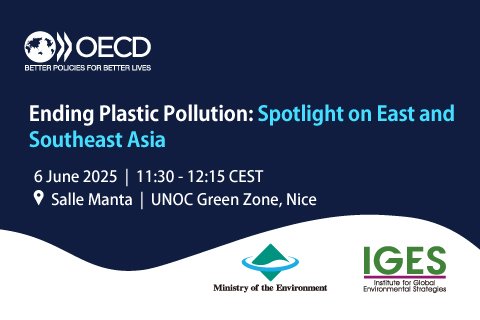
UN Ocean Conference Side Event
Ending Plastic Pollution: Spotlight on East and Southeast Asia
Background Plastic pollution is a global environmental issue. East and Southeast Asia are of strategic importance in the fight against plastic pollution, the rivers and coastlines of which are some of the most affected by plastic pollution. The...
Past Event

S-21 Project Open Public Event
Exploring Nature Positive Futures
Nature Positive is a global societal goal defined as ‘halt and reverse nature loss by 2030 on a 2020 baseline, and achieve full recovery by 2050’, in line with the mission of the Kunming-Montreal Global Biodiversity Framework (Nature Positive...
Related News
Announcement
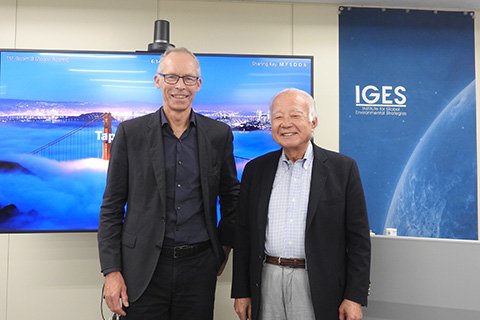
Dr. Johan Rockström Visits IGES and Delivers Special Lecture
On 9 October, Dr. Johan Rockström, the globally renowned scientist on planetary sustainability and leading researcher on planetary boundaries (Director of the Potsdam Institute for Climate Impact Research and Professor in Earth System Science at the...
Press Release
【ISAP2024】 The 16th International Forum for Sustainable Asia and the Pacific “Taking an Integrated Approach to Overcome the Triple Planetary Crisis”
The Institute for Global Environmental Strategies (IGES) will host the 16th International Forum for Sustainable Asia and the Pacific (ISAP2024). This year, the Plenary Sessions will be held on Tuesday, 23 July 2024 at Pacifico Yokohama as a hybrid...
Press Release

Announcing the Establishment of the Technical Support Unit for the IPBES Task Force on Scenarios and Models of Biodiversity and Ecosystem Services in IGES
On Friday 1 March 2024, the Institute for Global Environmental Strategies (IGES), in cooperation with the Ministry of the Environment, Japan, established the Technical Support Unit (TSU) for the Intergovernmental Science-Policy Platform on...
Related Projects
Project

Updated: August 2025
G7 / G20 Special webpage
Each feature page explains trends and highlights of major themes related to climate change, energy, and the environment at the G7/G20 summits.
Project
Updated: April 2025
Circular Economy and Resource Efficiency
In recent years, circular economy (CE) and resource efficiency (RE) have taken centre stage in the G7 and G20 processes, contributed to the sustainable development agenda (SDGs), and played a role in addressing climate change. Circular economic...
Project
Updated: December 2024
G20 (2024) Special webpage
Led by the Brazilian Presidency, the G20 Summit in 2024 is due to be held on 18-19 November in Rio de Janeiro. The world is now facing simultaneous and interlinked crises of climate change, biodiversity loss, and pollution. Moreover, prolonged...


